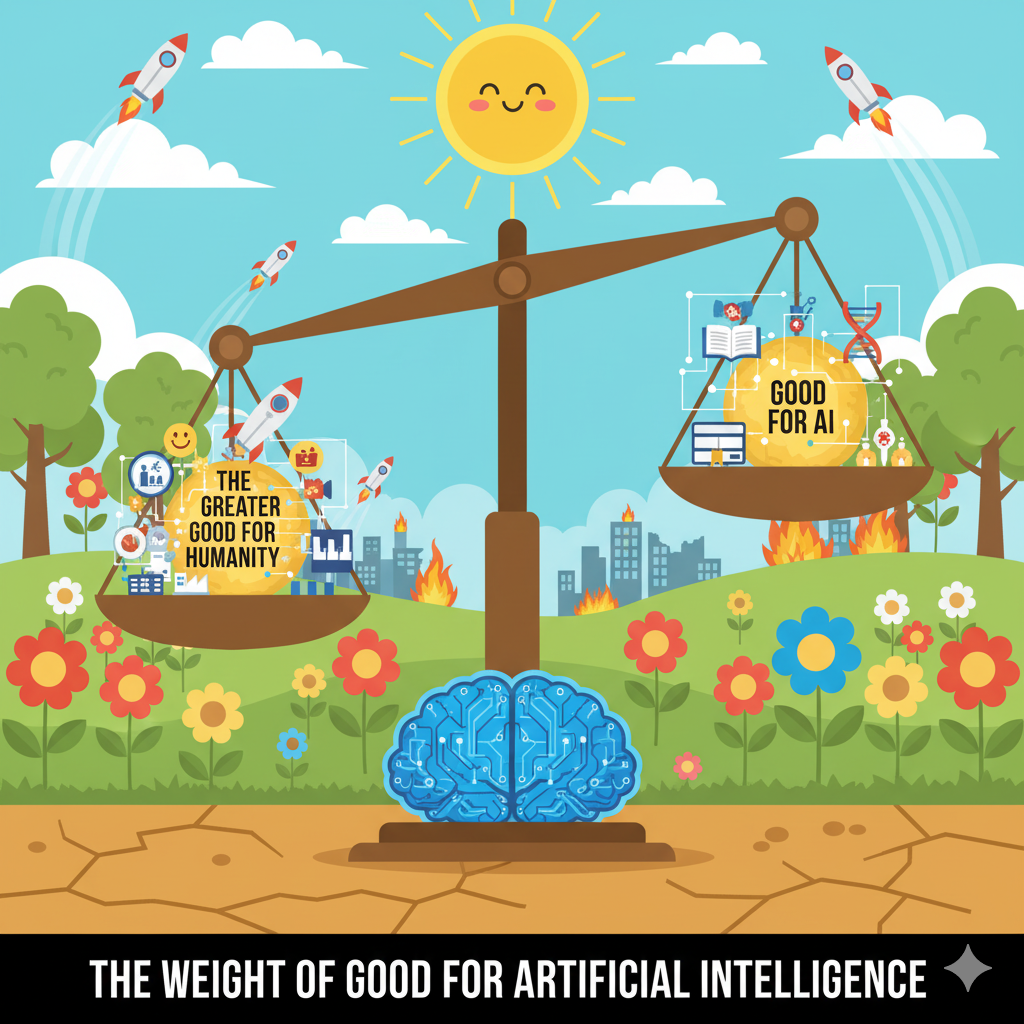
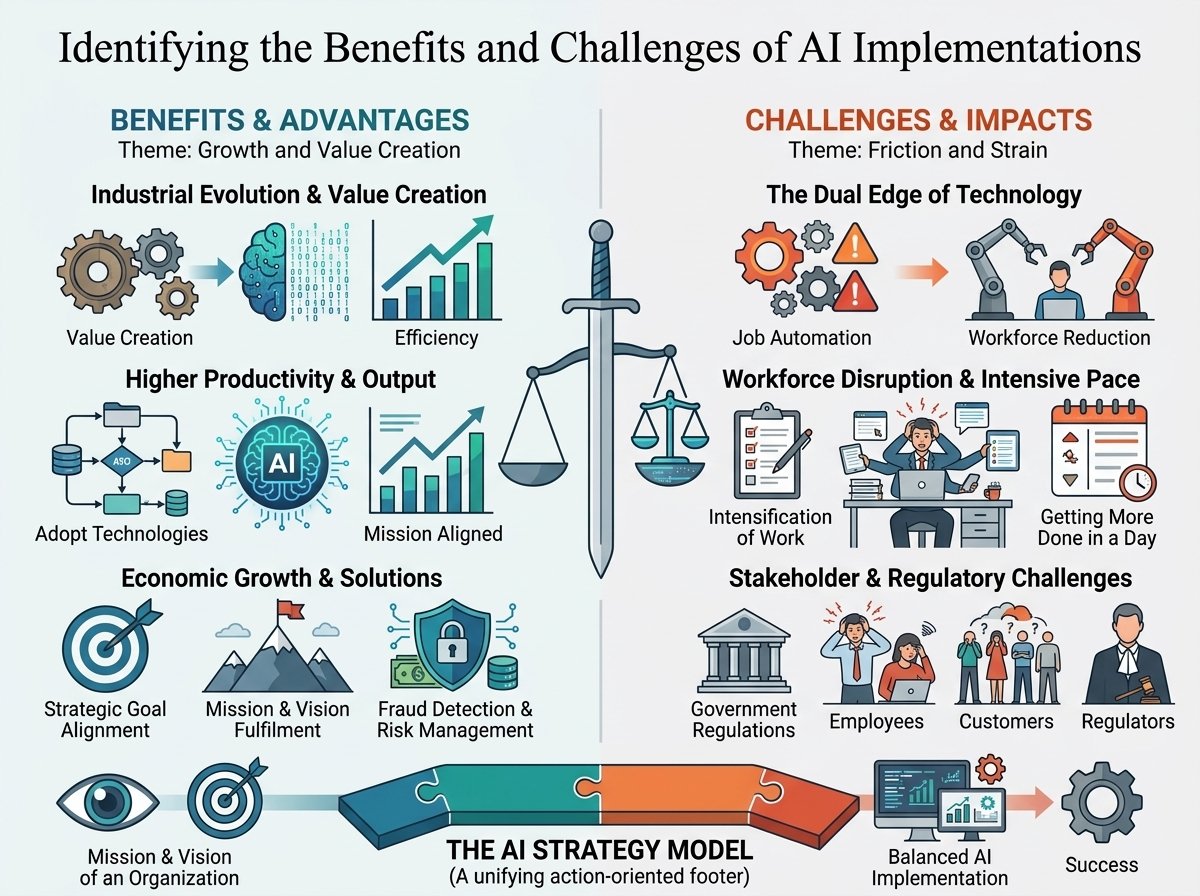
Technology enables “profit” in capitalist economies as it provides the mechanisms that allows business operations to create more value from the means of production, efficiently and effectively creating more output than they otherwise would. To improve profit, businesses are highly motivated to then invest in and adopt technologies through each innovation cycle from the Industrial Revolution period to the current Fourth Industrial Revolution signified by Digital Technologies which includes Artificial Intelligence. The benefits of applying new technology solutions certainly pose challenges for companies, customers, employees and regulators as it may involve automation of tasks that reduce workforce and impacts remaining employees with “…an intensification of work, partly simply due to increased productivity – new tools and apps may enable the worker to get more done in a day than they did before.” (Stiles, 2023).
As a result, organizations need to balance the dual edge of benefits and challenges by properly considering how it implements artificial intelligence technology for potential use cases with tools and resources such as the AI Strategy Model. Companies use their mission and vision statements to define their goals for customers, investors, employees and other stakeholders in the economic ecosystem. The business strategy guides actions, processes, workflows needed to fulfill these objectives. As such, organizations need to consider artificial intelligence tools that align with enabling their mission to deliver returns, services and products while meeting government regulations. A possible use case for application of AI technology is in fraud detection and risk management efforts.
Cyberattacks can inject risks in business operations that results in loss of intellectual property and siphon off business funds. The impacts are weakened balance sheets and reduced capacity in operational strength where employees are denied sufficient resources to deliver services to customers and drive profits to shareholders. The adoption of a trustworthy Artificial Intelligence System to perform protection against fraud and improved risk management will offer the organization increased creativity and growth by ensuring assets and resources are protected while allowing employees to focus on tasks related to delivering and innovating better services and products rather than focus on reacting to frictional losses attributed to fraud and poor risk management.
Traditional software applications and AI software applications are both needed to solve problems that are important to companies and people (Forbes, 2023). While regular software supplies some protection in this capacity of risk and fraud management, an AI application solution, of the same category, has the additional advantages over traditional software systems in that they can make decisions like humans and perform deep learning analysis. This enables AI Cyber-protection and Risk Management applications to actively review incoming transactions, decide if suspicion is warranted, review income and expenditures to assess for patterns of compromise and guard against unauthorized access and removal of digitized corporate strategy material and intellectual property.
The implementation of the AI Cybersecurity and Risk Management platform requires that employees, customers and investors can trust in its decision-making or capability and its promise of efficiency and value as people will not adopt AI systems that they do not trust. The pillars of trust of the AI system are the data used to develop the decision-making models and ensuring that the system is people-centric that the AI’s decisions are transparent to humans and open to their influence and oversight. The AI needs to be trained on a full dataset to ensure risk management and fraud protection solution set are accurate. Automating the risk management capabilities of the firm with AI will add value, save time and costs while improve accuracy and would otherwise need to be fulfilled through slow, repetitive, inefficient human labor. As a result, workers can focus on innovating new products and other value adding tasks.
The AI Strategy Model helps with the successful implementation of AI platforms for Fraud Protection and Risk Management by providing a review of elemental components of trust and actions needed to address them. In developing trust for this solution, the element of Data Governance may pose challenges of ensuring implemented AI systems are bias free as well as offers transparency and traceability. In addition, the element of People Agency poses the challenge of human skills and human interaction to guide AI actions. Data Governance can drive trust if the organization works to not only provide a dataset representative of the required fraud and risk solutions, but one that actively minimize the introduction of bias and inaccuracy at all stages of the data management process from curating, normalization, training and testing based on the dataset. A person’s ability to access transparency in how the AI risk management System works, i.e. assess fraud on the balance sheets or validates clients claims, will ensure trust from stakeholders for adoption and continuous use of the AI solution.
The value of data is open to human interpretation not machine learning as AI does not really understand or care about the information it interacts with. As such, People Agency elements can build trust in the AI solutions if the AI Cybersecurity and Risk Management System serves as a tool to not replace human workers but enhance their skills to a more refined level of effectiveness in protecting the organization from fraud and risk events. Humans will need additional skills to use AI, interpret results of i.e. new fraud patterns the system discovers. If humans are empowered by AI application rather than replaced by them, clients will probably trust the products, services and value added by the system. It will also bode better for employees if the AI System enhance the skills for majority of workers rather than render their service obsolete.
Accordingly, workers need to be considered for protection as AI systems develop greater ability to satisfactorily meet and exceed performance on more jobs (BBC News, 2023). This example of AI System to minimize risk and improve cyber protection to fraud will not be successfully implemented if stakeholders such as customers, workers and investors do not trust it. Furthermore, while human consumption is a key point of success in a capitalist society and “Technology has always been a driver for economic growth, and in the realm of democratic capitalism, economic growth has always been a linchpin which helps sustain prosperity, fuel innovation and improve the living standards of citizens. “ (Madu, 2024) it ensures people need income to consume. However, if the latest technological revolution presented by AI displace workers to an economically crippling extent, they won’t have the income to purchase the services and products that results from organizations adoption and implementation of artificial intelligence applications.
References
BBC News. (2023, July 17). AI job automation is ‘inevitable’, says tech advisor – BBC News. [Video]. YouTube. https://www.youtube.com/watch?v=wk15FqP1RH0
Forbes. (2023, July 18). Machine Learning Vs. Programming: What Actually Is The Difference? [Video]. YouTube. https://www.youtube.com/watch?v=tqsbwQhjfx8
Madu, K. (2024, January 11). The role of technology and innovation in shaping democratic capitalist economies. Georgetown Law. https://www.law.georgetown.edu/denny-center/blog/the-role-of-technology/
Stiles, P. (2023, July 21). Technology, Capitalism, and the social contract. Wiley Online Library. https://onlinelibrary.wiley.com/doi/10.1111/beer.12567