
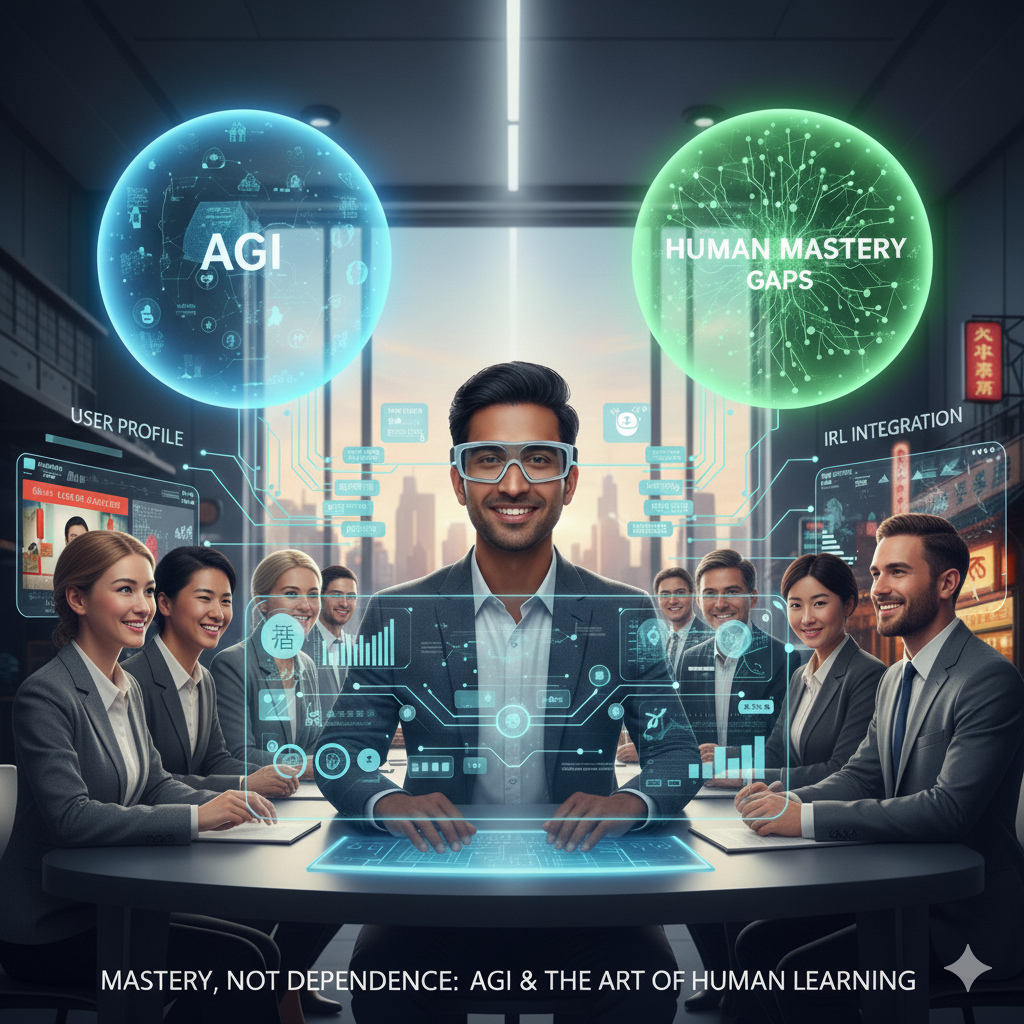
The ideal Artificial General Intelligence (AGI) system will be a friend, mentor, confidant and advisor that effectively meets the maturing needs of a person. In other words, the most desirable design for an Artificial Intelligence system is an enabler that scales the ability of a person to achieve a richer experience whether at work or play. The AGI platform will encompass a complex and intricate integration of machine learning technologies that are able to respond to the psychological, social, economic, business, career, life experience knowledge queries of its human host. Humans are complex social beings that are also highly individualistic while enjoying courteous and competent services whether from each other or delivered by artificial intelligence. As such, the future adoption, successful implementation, and widespread use of AGI systems need to be from agents that are human-centric and capable, not only in learning but in delivery of unique solutions, nuance and personable, white-gloved services to its human sponsor.
Artificial intelligence system designers have a challenge of creating this solution as todays Narrow AI systems, that specialized in limited domains solutions, will not fit this demand to interact with humans on a variety of devices from wearables to tablets and other smart devices as a new set of technologies may need to be invented (Dutta, 2025). People will gravitate to an Artificial General Intelligence system that can help a child, an adult or senior user with patient, courteous, clearly communicated step-by-step guidance, discussion instructions on a query. For example, a query can come from any of these age groups on how to make a “nice” drawing or a picturesque painting. An AGI system will need to recognize that by including the word “nice”, most human, though a newbie artist, are probably asking for guidance on how to create art that will not look too “amateurish”. The AGI system will need to understand this context and be capable of responding with a friendly understanding voice perhaps, emanating from a talking toy figure, instruct a child in one instance, on how to use crayons of various colors and background colors to etch the scene of a “day at the beach”. In another instance, an adult that wishes to paint for relaxation or a hobby may find value in the instructions from a desk-mounted AGI personal-digital-assistant-styled unit, as a lookalike to a futuristic version to Apple’s Siri with an LCD display, patiently prompt and walk its adult learner through a video rendition of creating the print of a beach vacation memory. The AGI unit may discuss styles of brush, mix colors, while illustrate by onscreen instruction. Furthermore, knowing the mind of this requestor to averting clean-ups, it originates and suggests an idea to its human host to consider using generative artificial intelligence options to create the memory onscreen instead of canvas, to avoid the mess of real paint. It even instructs him to create a fun and original work, generatively, in the style of his favorite artist, Van Gogh (Artsology.com, 2025). On the other hand, a senior user may feel comfortable with a robotic AGI system standing next to them providing instruction and companionship through painting activities done as a physical and mental activity to help keep their minds sharp and fingertips moving.
General Artificial Intelligent systems will need to not only address needs for humans of all ages that wish to paint but also needs to be capable to respond to a plethora of concerns across spectrums of concerns, cultures, languages and societies. We may argue that the hardware, software, data and philosophical disagreement as to whether all aspects of our physical world or human experience can be fully algorithmicized may prevent the construction of a truly capable artificial general intelligence system (Fjelland, 2020). Despite the doubt, the possibility and required flexibility of generalized artificial intelligence system is visible in today’s ChatGPT platforms offered by OpenAI to perform human text generation and translation across various applications (Hughes, 2023). Mankind has historically tinkered with inventions and task them with the purpose of extending our drive to minimize the toil required to reap and maximize the benefits available to us to achieve joyful experiences, grow our wealth and improve our quality of life. The ability of our feet and will to explore is extended by the innovation in a litany of transportation modes from spaceships, submarines, e-bikes to electric vehicles to flying cars to “cut traffic congestion” (Westhoff, 2025). Our desire to extend our eyes to see and understand the world near and far has resulted in fantastic devices such as the electron microscope, space telescopes and now artificial intelligence image recognition to see patterns and insights in the fabric of our world or disease growing in our body. Much of our inventions also facilitate job whether manuscripts and books of adventure or obsolete hand cranked movie projector from 1910 for hand drawn animation, or karaoke device to sing along to our favorite tunes, or leapfrog to all types of movie genre’s available for streaming with Netflix. In pursuit of easy access to knowledge we invented papyrus, printing press, printers, smartphones.
One of the most salient super-powers of AI is its promise of personalized solution for any one to address the questions we each hold most dear. So if someone wanted to become a linguist in Mandarin, theoretically an AI system could design a learning program suited to the person and then take them through the practice, lessons, application of knowledge to effectively ingrain this new knowledge skill.
Artificial General Intelligence will not simply provide an answer to helping a person to fulfill a mission, it will design a solution with an understanding of that human being, how they learn (visually, reading, etc.) what their habits are (a morning person may like Chinese lessons at 5AM before coffee) as well as other insights to design a highly effective instructional program for marked progress in the shortest time. I wonder if an emergent capability of AI employed in this way of highly custom teaching would include an emergent capability to ensure the student is not using the AI as a crutch to learn the new language and just over dependent on it for encouragement and corrections in its lessons? If not, Artificial General Intelligent designers should ensure these systems do not stand in for us at all steps of a process or operation but to merely give us a clear outline and details where necessary for humans to pursue a solution path that requires in some cases that we fill in certain gaps along the way. So for our example of learning Mandarin, the AI may suggest the learner take a two week trip to China or a days trip to the nearest China Town to interact with speakers and practice the language at a local business.
AI replacement of human intelligence, curiosity and spontaneity is a challenge of moral and existential concern. However, if we are smart enough to invent AI and recognize this issue hopefully, we will be able to provide viable intentional solutions, as a society, as well.
We employ automation in our factories, business applications, office computer and other technology to simplify our labor to spend less time at work and more on leisure. Artificial General Intelligence will be even closer to us from the factory, to our homes and possibly implanted in our bodies to function in a hybrid arrangement of higher intelligence moderated by the emotions and sentience of our human nature, as Tronde Arne Undheim, co-founder of Yegii, discussed in the module of general intelligence that may be implanted to seamlessly communicate with the human mind. While inventions have rapidly developed civilization by providing mankind with development what are like extra limbs, senses or abilities, (i.e. earthmovers to mine minerals or gene therapy to manipulate DNA) artificial general intelligence will differ in that it multiplies the impact of a single person, with scaled centipede like capabilities from two legs to a thousand legs, like the Eumillipes persephone millipede species of Australia with over 1200 legs (Duke, 2021), or in terms of human- power, able to perform like the brains and brawn of hundreds or thousands of other persons, required to run a Fortune 1000 company.
However, we know that more does not necessarily suggest better as the widespread adoption of artificial general intelligence system depends on how human-centric and predictable the technology is in serving varied societal needs in complex environments as there is a danger that AI systems can exhibit emergent features or abilities that are not explicitly designed. Furthermore, the manifestation of emergence in Level 1 AGI systems such as ChatGPT and other Large Language Systems illustrates the concern as reported in Quanta Magazine where, “…Emergence leads to unpredictability…which…makes it difficult for researchers to anticipate the consequences of widespread use.” (Ornes, 2023). While level 1 or 2 AI system offers rewards of a competent Narrow AI system it also poses the risks of manipulation and radical tendencies by boxing in its audience to information that reinforces narrow viewpoints. Society will need to responsibly and ethical develop future AI for a layer of reasons.
As the early development of artificial intelligence highlights there are similar issues with systems of even greater autonomy, i.e. Level 4 or 5 may result in the development of Virtuoso AI that risks power concentration in a few tech companies or wealthy nations that can afford to build these systems while the remainder of humanity get displaced from jobs and driven into digital despair. The future of AI is brighter if artificial general intelligent systems work in partnership with humans to create new possibilities in economies of scales and improved quality of life for all, rather than replace us.
References
Artsology.com. (2025, August). Impossible Van Gogh Paintings. artsology.com. https://artsology.com/impossible-van-gogh-paintings.php
Duke, C., & LiveScience. (2021, December 17). Newfound millipede breaks world record for the most legs. Scientific American. https://www.scientificamerican.com/article/newfound-millipede-breaks-world-record-for-the-most-legs/
Dutta, S. (2025, August 22). Define Generalized AI Systems. eCornell – The Future of AI. https://lms.ecornell.com/courses/1851251/pages/watch-define-generalized-ai-systems?module_item_id=34301273
Fjelland, R. (2020, June 17). Why general artificial intelligence will not be realized. Nature. https://www.nature.com/articles/s41599-020-0494-4
Hughes, A. (2023, September 25). ChatGPT: Everything you need to know about OpenAI’s GPT-4 tool. BBC Science Focus Magazine – science, nature, technology, Q&As. https://www.sciencefocus.com/future-technology/gpt-3
Ornes, S. (2023, March 16). The unpredictable abilities emerging from large AI models. Quanta Magazine. https://www.quantamagazine.org/the-unpredictable-abilities-emerging-from-large-ai-models-20230316/
Westhoff, N. (2025, August 27). Manufacturer tests jetsons-inspired flying vehicle that could save lives: “rapid assistance is needed in hard-to-reach places.” Yahoo! https://tech.yahoo.com/transportation/articles/manufacturer-tests-jetsons-inspired-flying-134500487.html